> For the complete documentation index, see [llms.txt](https://help.distro.so/llms.txt). Markdown versions of documentation pages are available by appending `.md` to page URLs; this page is available as [Markdown](https://help.distro.so/routing-forms/overview.md).

# Overview

<figure><img src="/files/XILCQ5SLo9SujpQD1oYy" alt=""><figcaption></figcaption></figure>

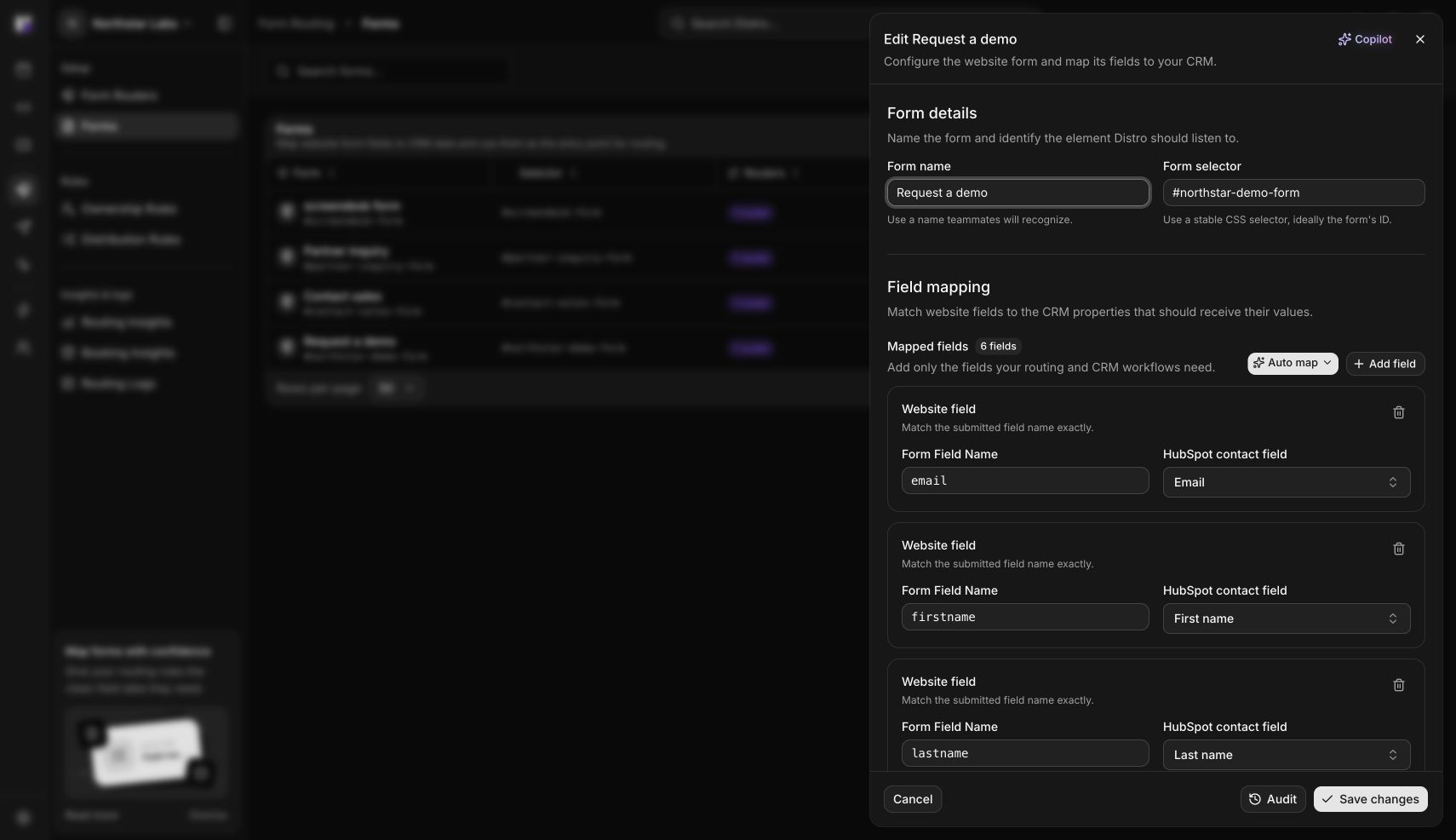
Form field mapping in Distro connects your web form fields to your routing system, enabling intelligent meeting distribution based on the information your prospects provide.

{% hint style="success" %}
When you integrate Distro with your web forms, it simply listens for form submissions to trigger the scheduling experience. This means:

* Your form continues to function exactly as before
* Distro only activates the scheduling widget when a form is submitted
* No interference with your current form setup or data collection processes
  {% endhint %}

### How to map your web forms

{% stepper %}
{% step %}
Navigate to **Form Routers** in the sidebar
{% endstep %}

{% step %}
Select "Forms"
{% endstep %}

{% step %}
Click "+ New Form"

<figure><img src="/files/Hqs0oTy2XZ9EegNPBK21" alt=""><figcaption></figcaption></figure>
{% endstep %}

{% step %}
Enter a title for the form

* Enter a unique, descriptive name for your form
* This name will be used for identification within Distro
* Example: "Marketing Website Contact Form"

<figure><img src="/files/p4QIr1lGrFqu7tAgowjI" alt=""><figcaption></figcaption></figure>
{% endstep %}

{% step %}
Enter the form selector

View how to integrate the different forms below
{% endstep %}

{% step %}
Map the different fields between your form and your crm fields
{% endstep %}
{% endstepper %}

### Supported Forms

<table data-view="cards"><thead><tr><th></th><th></th><th></th><th data-hidden data-card-target data-type="content-ref"></th></tr></thead><tbody><tr><td><a href="/pages/Kp4zBRZFhdnEOYvXxPuu">Custom HTML form</a></td><td></td><td></td><td><a href="/pages/Kp4zBRZFhdnEOYvXxPuu">/pages/Kp4zBRZFhdnEOYvXxPuu</a></td></tr><tr><td><a href="/pages/skMvNgjaWk9AZkhCW7mx">HubSpot form</a></td><td></td><td></td><td><a href="/pages/skMvNgjaWk9AZkhCW7mx">/pages/skMvNgjaWk9AZkhCW7mx</a></td></tr><tr><td><a href="/pages/h3g4vQMjFDVi8FJLT7Ym">Marketo</a></td><td></td><td></td><td><a href="/pages/h3g4vQMjFDVi8FJLT7Ym">/pages/h3g4vQMjFDVi8FJLT7Ym</a></td></tr></tbody></table>


---

# Agent Instructions
This documentation is published with GitBook. GitBook is the documentation platform designed so that both humans and AI agents can read, navigate, and reason over technical content effectively. Learn more at gitbook.com.

## Querying This Documentation
If you need additional information that is not directly available in this page, you can query the documentation dynamically by asking a question.

Perform an HTTP GET request on the current page URL with the `ask` query parameter, and the optional `goal` query parameter:

```
GET https://help.distro.so/routing-forms/overview.md?ask=<question>&goal=<endgoal>
```

`ask` is the immediate question: it should be specific, self-contained, and written in natural language.
`goal` is optional and describes the broader end goal you are ultimately trying to accomplish on behalf of the user. GitBook uses it to tailor the answer towards what is most useful for that goal.

The response will contain a direct answer to the question and relevant excerpts and sources from the documentation.

Use this mechanism when the answer is not explicitly present in the current page, you need clarification or additional context, or you want to retrieve related documentation sections.
